MemoHoney Official Website › Articles › Reading the complete label
Reading the complete labelSeven Panel Lines and Six Marketing Names Are Not a Contradiction
The formal MemoHoney Supplement Facts panel lists seven dietary ingredients, including calcium. The marketing tile highlights six names. Each is a different record with a different job.
The panel and the marketing list count different things
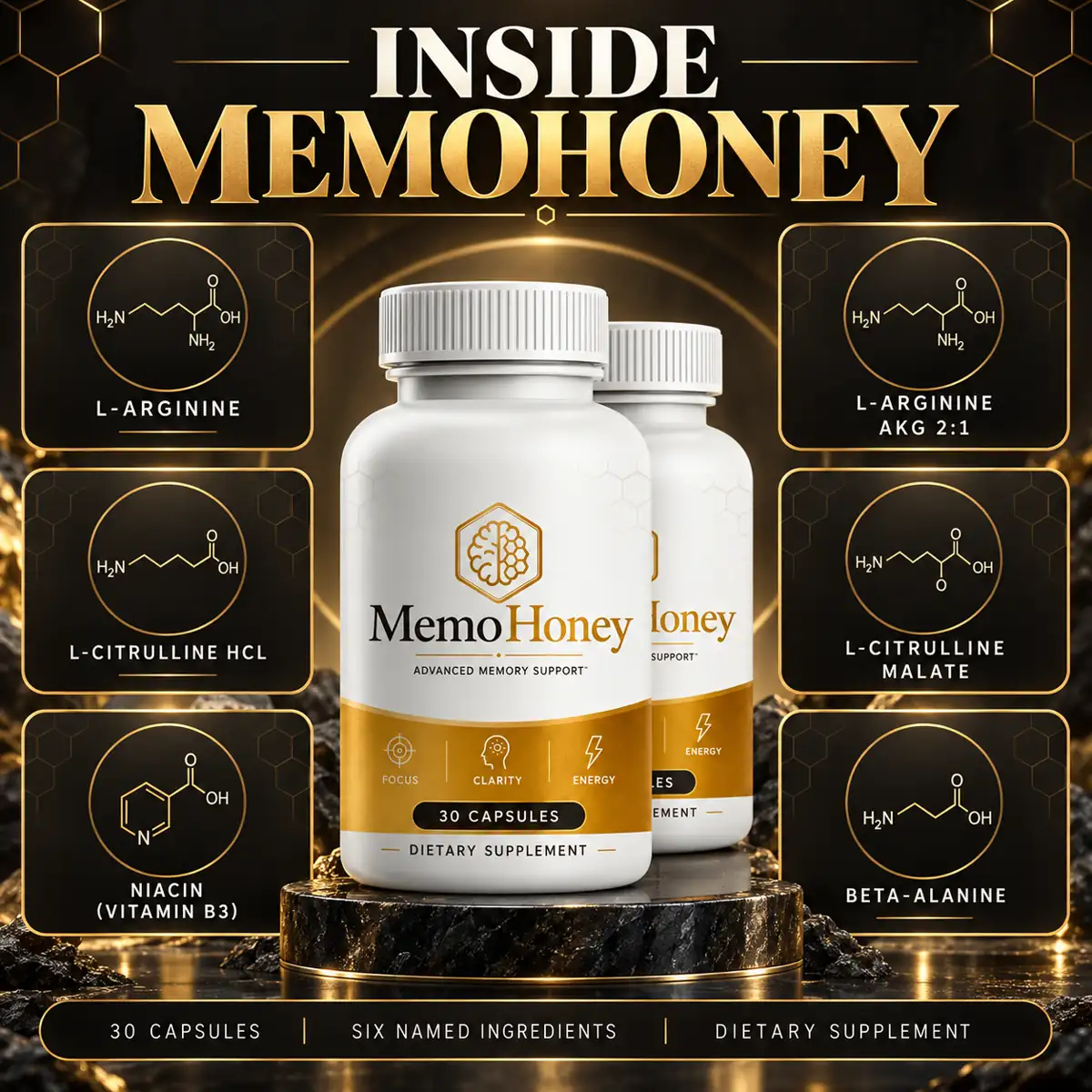
This MemoHoney record contains two visible ingredient lists. The Supplement Facts panel on the full bottle wrap lists Niacin, Calcium, L-Arginine, L-Arginine AKG 2:1 Extract, L-Citrulline HCl, L-Citrulline Malate and Beta Alanine. The advertising tile and seller ingredient prose name six ingredients and leave out calcium. The difference is a count of seven panel lines versus six marketing names.
That is not automatically a contradiction. The two surfaces have different purposes. A Supplement Facts panel is the formal product disclosure surface. A tile graphic is a selective marketing surface. The right way to read them is not to make the two lists agree by deleting the extra panel line, but to say exactly what each list includes and where it came from.
The panel is the record for serving size and amounts. It says one capsule per serving and 30 servings per container. The advertising list remains useful as a statement of what the seller chooses to feature. It is not the superior source for a component that the formal panel displays but the tile does not name.
| Record | What it lists | What it does not establish alone |
|---|---|---|
| Supplement Facts panel | One serving and seven dietary ingredient lines | A clinical result or individual suitability |
| Marketing tile | Six highlighted names | The complete declared panel |
| Calcium line | 18 mg calcium carbonate / 1.5% DV | The formula's primary purpose |
| Ingredient amount | The stated amount per serving | That it matches a study or produces an effect |
The formal panel is the product source for serving size and disclosed quantities. A selective marketing graphic should not be used to erase an extra panel line.
Calcium is the seventh dietary panel line
The line left out of the six-name marketing copy is Calcium, listed as calcium carbonate at 18 mg, or 1.5% of the Daily Value, per one-capsule serving. That is a factual label detail. It does not mean calcium is the product's main purpose, and it does not mean the bottle should be treated as a meaningful calcium supplement. It means the formal panel names a seventh dietary ingredient that a careful account should not erase.
This is a useful example of why a buyer should read a panel before relying on a clean feature graphic. A marketing image can be visually clearer and still be less complete. The absence of calcium from the tile says that it was not selected for emphasis; it does not establish that calcium is absent from the capsule.
The practical conclusion is modest. If the buyer needs to know the panel's complete listed ingredients, the panel wins. If the buyer wants to understand what the seller emphasizes in its marketing, the tile can show that too. Both are relevant, but they answer different questions.
Printed quantities answer a different question than research
Unlike several sibling product packs, this one has a complete amount panel. Niacin is listed at 7.5 mg NE, calcium at 18 mg, L-Arginine at 200 mg, L-Arginine AKG at 200 mg, L-Citrulline HCl at 100 mg, L-Citrulline Malate at 100 mg and Beta Alanine at 40 mg. These are the product's disclosed amounts per one-capsule serving.
Knowing an amount is not the same as knowing that the amount produces a particular effect. The published work on the amino-acid ingredients commonly uses gram-scale quantities of an individual compound, with populations and outcomes that differ from the product's broad memory-support presentation. The amount panel makes a comparison possible; it does not make the comparison favorable by itself.
The ingredients page puts the panel beside the research record rather than hiding either one. That is the right use of a disclosed amount: identify what is in this serving, identify what a study used, identify the mismatch or limit, and avoid pretending that a study of another dose or formulation is a study of this capsule.
Seven lines do not necessarily mean seven separate purposes
A product can have seven panel lines while its advertising uses a different count of featured ingredients. It can also have chemical forms that resolve to related compounds. Counting is therefore a reading exercise, not a shortcut to judging quality. A longer list may be more complete, but it does not automatically mean broader evidence or a stronger effect.
Here, the panel tells the buyer exactly which seven dietary ingredients are declared per serving. The marketing list tells the buyer which six names are highlighted in the presentation. The two counts should be recorded accurately rather than turned into a contest over which number sounds better. The relevant issue is disclosure: the formal panel preserves a line the marketing tile omits.
This distinction helps in comparisons. When two products have different marketing styles, start with their Supplement Facts panels, serving sizes and amounts. Then look at the actual studies behind the individual ingredients. It is more work than comparing a headline count, but it is less likely to make a design decision look like nutritional evidence.
A full panel still has limits
The full panel improves the record because it provides named ingredients, amounts, a serving size and other ingredients. It does not provide every answer a buyer may want. A panel cannot establish that a formula is clinically tested for memory, that an individual will respond in a particular way, or that the mixture is appropriate alongside a reader's medicines and conditions.
The other-ingredients line names hypromellose vegetable capsule, vegetable stearate and silicon dioxide. That can be relevant for someone checking a capsule shell or a declared excipient. It does not replace product-specific testing information for a strict dietary or medical need. A buyer who requires a particular documentation level should ask the seller a precise question before purchase.
The label also cannot decide whether a new memory concern should be managed with a supplement. The most useful label is still only one record. A person with worsening recall, confusion, a reaction or an interaction concern needs a health professional who can consider the person rather than a generic panel.
Read the complete panel first, then the presentation
A short reading order avoids most confusion. Start with the serving size and the full panel. Note the declared ingredient lines and quantities. Then read the front label and marketing graphic for the claims and ingredients the seller highlights. Finally, compare any research statement with the ingredient, quantity and population actually studied.
This does not punish marketing. A tile graphic can make a page easier to scan. It simply prevents the graphic from being treated as a complete substitute for the panel. When the two differ, a buyer can report both accurately: six highlighted marketing names and seven declared dietary panel lines, including calcium.
The approach also leaves a buyer free to decide that the available information is not enough. A panel is clearer than an incomplete graphic, but it does not remove every uncertainty. A careful decision may be to ask another question, consult a pharmacist, or leave the product unpurchased rather than stretching a label into more certainty than it has.
Read the MemoHoney panel and terms before ordering
The printed serving, named panel lines, daily direction, and the specific questions the product record cannot answer.
Two bottles $158 · six bottles $294 · 60 days from purchase to change your mind
Order MemoHoney From This DeskLot MEM-26/ME-4830 · 30 capsules a bottle · dispatched inside the United States
What this record can support
The front label, the Supplement Facts panel, an ingredient-tile graphic, a seller description, an order record and an individual research paper are different records. The label can identify the claim printed on the bottle. The panel can identify a serving and listed quantities. A seller description can state what it chooses to emphasize. A study can report the amount, people and outcome it examined. They should not be asked to become each other.
That means an incomplete answer can remain incomplete. A panel amount does not establish that the amount will create a result. A marketing ingredient list does not erase the panel line it left out. A timing instruction does not predict an effect. If the question that matters to a buyer is not answered by the available record, not buying is a careful outcome rather than a failure to interpret marketing optimistically.
After a purchase, the same separation helps keep questions in the right place. The product and order records can support a service question. The complete label can be taken to a pharmacist or clinician when medicines, reactions, a condition or a change in memory are relevant. Customer service and a product page are not a substitute for individual medical assessment.
The useful habit is simple: identify which record has the exact fact, preserve it, ask the next precise question, and do not borrow certainty from an adjacent piece of packaging. That keeps the product information readable without allowing the strongest-looking surface to silently fill every gap.
- Use the Supplement Facts panel for the product's listed serving and amounts.
- Use seller copy and tiles for what they literally say, not for omitted facts.
- Use a direction as a routine instruction, not as a personal outcome timeline.
- Use an order ID and current instruction for a service issue.
- Use a pharmacist or clinician for medicine and health questions.
What follows is about a supplement, not about a treatment, and it is not advice from anybody qualified to give you any. If your recall has shifted enough that you or somebody close to you has remarked on it, book the appointment rather than the bottle: MedlinePlus lists what a clinician will want to hear about.
- Questions and Answers on Dietary Supplements. U.S. Food and Drug Administration. https://www.fda.gov/food/information-consumers-using-dietary-supplements/questions-and-answers-dietary-supplements
- Using Dietary Supplements Wisely. National Center for Complementary and Integrative Health, National Institutes of Health. https://www.nccih.nih.gov/health/using-dietary-supplements-wisely
- Memory. MedlinePlus, U.S. National Library of Medicine. https://medlineplus.gov/memory.html
- Dolan E, Swinton PA, Painelli VS, et al. A Systematic Risk Assessment and Meta-Analysis on the Use of Oral β-Alanine Supplementation. Adv Nutr. 2019;10(3):452-463. PMID 30980076. https://pubmed.ncbi.nlm.nih.gov/30980076/
- Khalaf D, Krüger M, Wehland M, et al. The Effects of Oral l-Arginine and l-Citrulline Supplementation on Blood Pressure. Nutrients. 2019;11(7):1679. PMID 31336573. https://pubmed.ncbi.nlm.nih.gov/31336573/