MemoHoney Official Website › How It Works
How It WorksHow MemoHoney is meant to work, link by link
Four of the seven ingredients raise plasma arginine so the body can make more nitric oxide, which relaxes blood vessels; brain tissue depends on steady perfusion. Beta-alanine builds carnosine and niacin feeds NAD. That is the proposed chain. The link nobody has tested is the last one, from this capsule to a measured change in memory.
A mechanism is a hypothesis with a diagram attached. This page follows the chain to the point where the published evidence stops.
Link one: what the MemoHoney amino acids do in the body
Nitric oxide synthase converts arginine into nitric oxide. Nitric oxide diffuses into the smooth muscle wrapped around a blood vessel and tells it to relax, which widens the vessel and lowers the resistance blood meets. This is not controversial; it is the mechanism a Nobel prize was given for and it underlies several ordinary medicines.
Getting arginine into the blood is the awkward part. Followed with a label, dietary arginine is largely consumed before it arrives, by the gut wall and by urea synthesis in the liver (a stable-isotope study of dietary arginine). Citrulline avoids that route and is converted to arginine in the kidney instead, which is why it raises plasma arginine more dependably (a human citrulline availability study).
So the four blood-flow names on this label are not four ingredients. They are two strategies for one job, with two salt forms of each, and between them they come to 600 mg a capsule.
Link two: why MemoHoney points that mechanism at the brain
Brain tissue is a small fraction of body weight and takes a disproportionate share of resting blood flow. It stores almost no fuel, so it depends on delivery rather than on reserves, and the small vessels that do the delivering are regulated locally and continuously.
That makes perfusion a reasonable thing to be interested in. It is also why the blood pressure evidence in this field is more convincing than the supplement evidence: intensive blood-pressure control reduced probable dementia in a large randomised trial (SPRINT MIND), which is the same mechanism approached with a medicine and a target rather than with an amino acid.
The one citrulline trial that actually measured cerebral oxygenation did so during sprint interval training at 8.8 g a day for five days (the citrulline cerebrovascular trial). It is the nearest published point to this product's story, and the distance between an athlete mid-sprint and an adult at a desk is the distance this page is about.
Link three: what the other two MemoHoney ingredients contribute
Beta-alanine and carnosine
Beta-alanine is the rate-limiting half of carnosine, and carnosine buffers acid. In muscle that is well established; in brain tissue it is a smaller and newer literature. The study worth knowing gave 2.4 g a day to adults aged 60 to 80 and imaged the hippocampus (the beta-alanine brain-imaging trial). The sports meta-analysis at 3.2 to 6.4 g a day found a pooled effect size of 0.18 (the 2017 beta-alanine meta-analysis).
Niacin and NAD
Niacin becomes NAD and NADP, which carry electrons through energy metabolism in every cell including neurons. This is textbook nutrition rather than a hypothesis. The cognitive interest comes from the dementia of severe deficiency and from an observational cohort where higher dietary niacin tracked with lower Alzheimer risk (the Chicago Health and Aging Project analysis). Correcting a deficiency and enhancing a brain that has none are different propositions.
Where the MemoHoney chain stops
Each link above is defensible on its own. The chain as a whole has never been tested, because no trial exists of this capsule, or of these ingredients combined, on any cognitive outcome.
There is also an arithmetic problem sitting under the biology. The amounts that produced the results cited here are grams: 12 g of arginine AKG, 8.8 g of citrulline HCl, 8 g of citrulline malate, 2.4 g of beta-alanine. The panel on this bottle gives them 200 mg, 100 mg, 100 mg and 40 mg, between a sixtieth and an eighty-eighth of each trial's daily amount, with niacin the honourable exception at 7.5 mg, an ordinary nutritional amount.
That does not mean nothing happens. It means the honest description is a plausible mechanism at a small dose, which is a different thing from a tested product, and it is why the whole of this website stops short of saying the capsule improves memory.
It is not saying the formula is inert, and it is not saying the mechanism is fake. It is saying that between the mechanism and a measured change in a person there is a step nobody has published, and that a buyer is entitled to know which step that is before spending $158.
Three things with better evidence than MemoHoney has
- Treating hearing loss. A randomised trial in older adults at higher risk found hearing treatment slowed cognitive change over three years (the ACHIEVE hearing trial).
- Treating blood pressure to a lower target. Fewer cases of probable dementia in a large randomised trial (SPRINT MIND).
- Sleep. Consolidation of memory during sleep is one of the better-established findings in the field (a 2026 review of sleep and memory consolidation), and it costs nothing.
Those three sit on a page that sells a capsule because a reader deciding what to do about memory should see the whole shelf. None of them is sold here and this desk earns nothing from any of them.
They are also not alternatives in the strict sense. Nothing stops a healthy adult doing all three and taking MemoHoney as well. What they do is set the order of operations: the capsule is the small, cheap, reversible addition, not the foundation.
Sources behind this MemoHoney mechanism page
- Mariotti F, Petzke KJ, Bonnet D, et al. Kinetics of the utilization of dietary arginine for nitric oxide and urea synthesis: insight into the arginine-nitric oxide metabolic system in humans. Am J Clin Nutr. 2013;97(5):972-9. PMID 23535108. https://pubmed.ncbi.nlm.nih.gov/23535108/
- Rougé C, Des Robert C, Robins A, et al. Manipulation of citrulline availability in humans. Am J Physiol Gastrointest Liver Physiol. 2007;293(5):G1061-7. PMID 17901164. https://pubmed.ncbi.nlm.nih.gov/17901164/
- Li A, Li H, Chen J. The effects of L-citrulline supplementation on cerebrovascular function during sprint interval training in taekwondo athletes. J Exerc Sci Fit. 2025;23(3):222-228. PMID 40474881. https://pubmed.ncbi.nlm.nih.gov/40474881/
- Ostfeld I, Zamir A, Ben-Zeev T, et al. β-Alanine supplementation improves fractional anisotropy scores in the hippocampus and amygdala in 60-80-year-old men and women. Exp Gerontol. 2024;194:112513. PMID 38971131. https://pubmed.ncbi.nlm.nih.gov/38971131/
- Saunders B, Elliott-Sale K, Artioli GG, et al. β-alanine supplementation to improve exercise capacity and performance: a systematic review and meta-analysis. Br J Sports Med. 2017;51(8):658-669. PMID 27797728. https://pubmed.ncbi.nlm.nih.gov/27797728/
- Morris MC, Evans DA, Bienias JL, et al. Dietary niacin and the risk of incident Alzheimer's disease and of cognitive decline. J Neurol Neurosurg Psychiatry. 2004;75(8):1093-9. PMID 15258207. https://pubmed.ncbi.nlm.nih.gov/15258207/
- Williamson JD, Pajewski NM, Auchus AP, et al. Effect of Intensive vs Standard Blood Pressure Control on Probable Dementia: A Randomized Clinical Trial. JAMA. 2019;321(6):553-561. PMID 30688979. https://pubmed.ncbi.nlm.nih.gov/30688979/
- Lin FR, Pike JR, Albert MS, et al. Hearing intervention versus health education control to reduce cognitive decline in older adults with hearing loss in the USA (ACHIEVE): a multicentre, randomised controlled trial. Lancet. 2023;402(10404):786-797. PMID 37478886. https://pubmed.ncbi.nlm.nih.gov/37478886/
- Yasser E, Ayache L, El Khayat H, et al. Sleep and memory consolidation: Neural and cognitive perspectives. Prog Brain Res. 2026;299:137-176. PMID 42547206. https://pubmed.ncbi.nlm.nih.gov/42547206/
- Using Dietary Supplements Wisely. National Center for Complementary and Integrative Health, National Institutes of Health. https://www.nccih.nih.gov/health/using-dietary-supplements-wisely
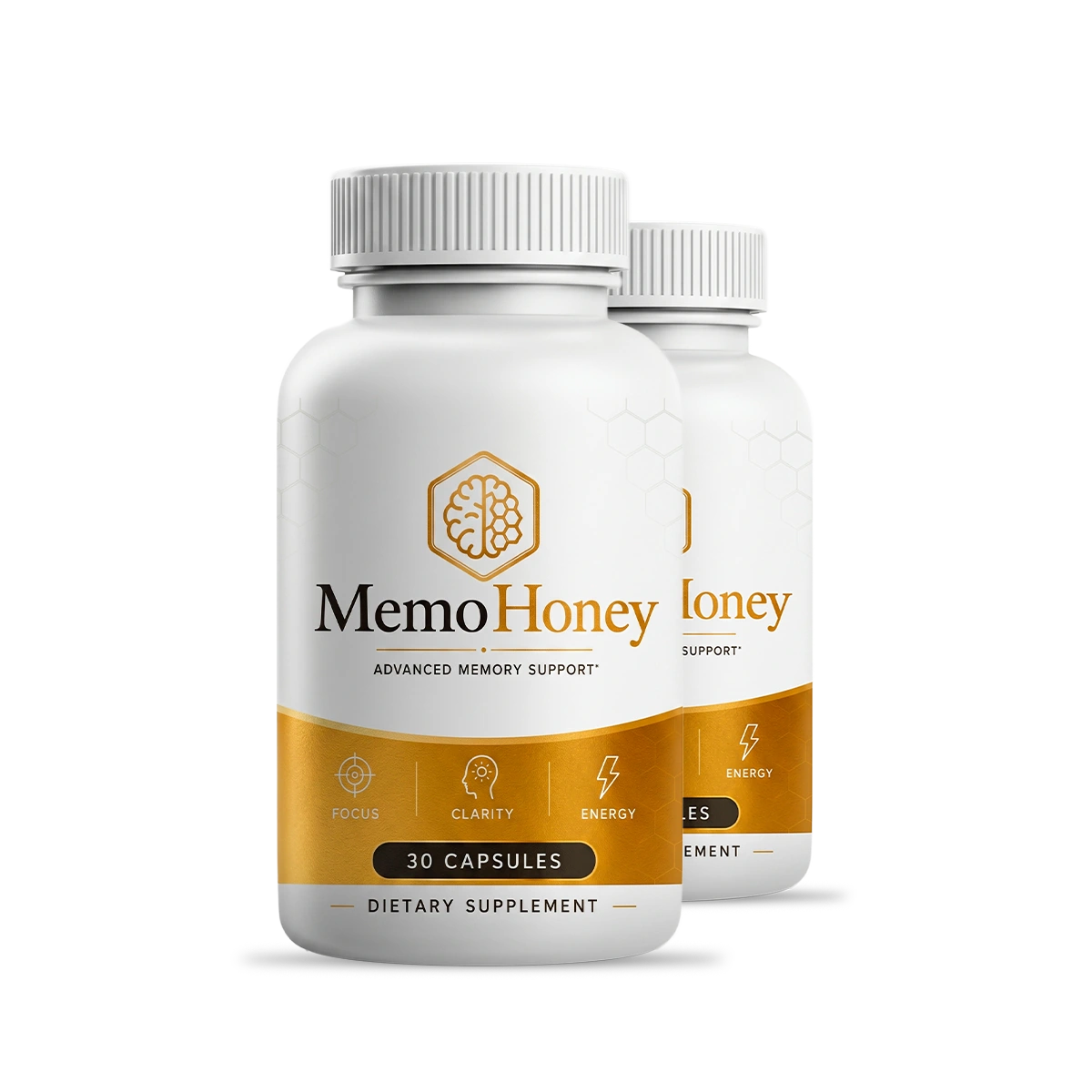
Order MemoHoney knowing what the mechanism does and does not say
A plausible chain at a small, honestly printed dose is what this bottle offers, and the 60-day window from the date of purchase is what makes trying it a reversible decision.
Two bottles $158 · six bottles $294 · 60 days from purchase to change your mind
Order MemoHoney From This DeskLot MEM-26/ME-4830 · 30 capsules a bottle · dispatched inside the United States