MemoHoney Official Website › Articles › Reading a label
Reading a labelFour of the six names do one job
The tile graphic names six ingredients, and four of them are attempts at the same mechanism: raise plasma arginine so the body can make more nitric oxide. Counted by idea rather than by molecule, this is a three-idea formula, and the recount works on any label.
What follows is about a supplement, not about a treatment, and it is not advice from anybody qualified to give you any. If your recall has shifted enough that you or somebody close to you has remarked on it, book the appointment rather than the bottle: MedlinePlus lists what a clinician will want to hear about.
Six names on the graphic
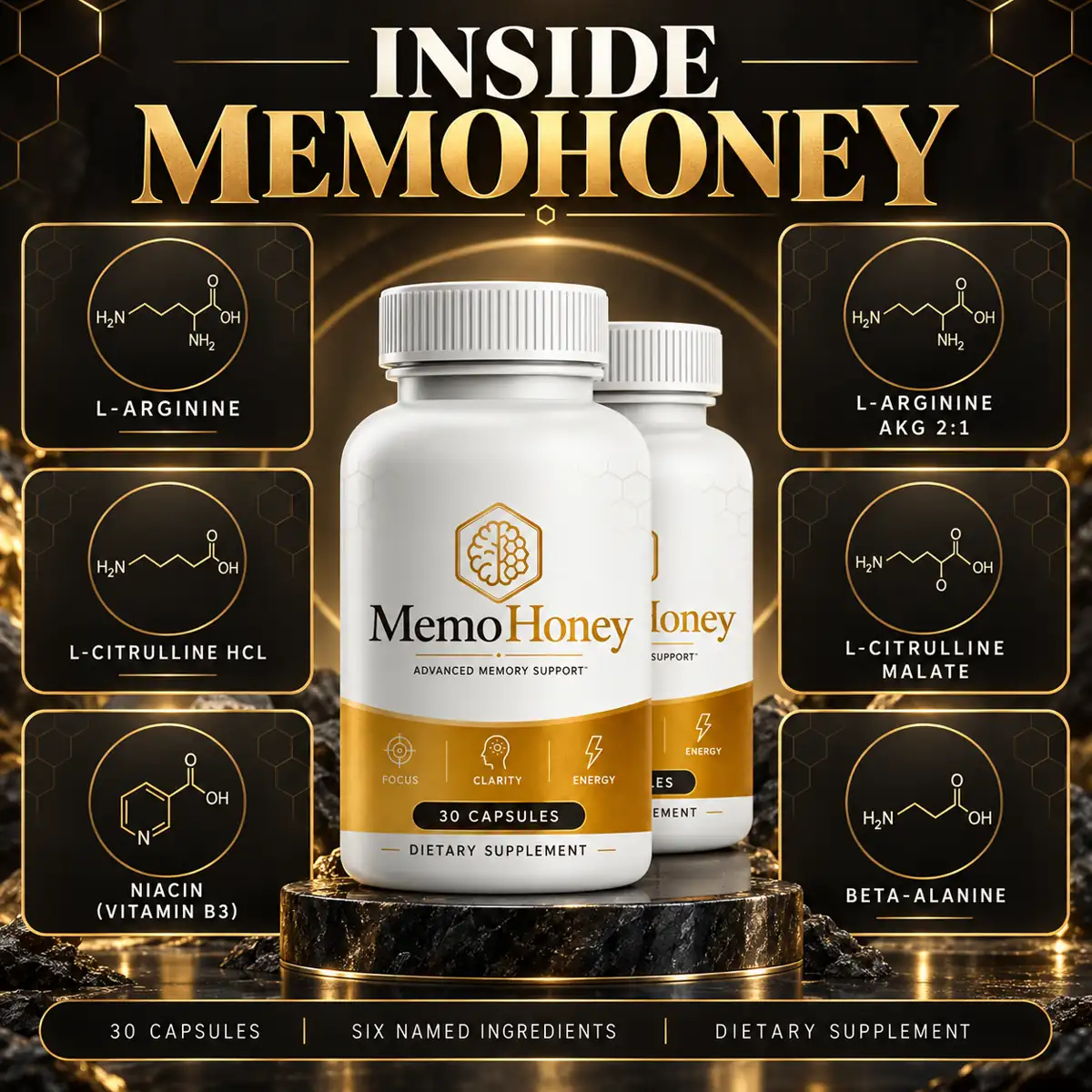
The MemoHoney tile graphic is headed INSIDE MEMOHONEY and it names six ingredients: L-Arginine, L-Arginine AKG 2:1 Extract, L-Citrulline HCL, L-Citrulline Malate, Niacin (Vitamin B3) and Beta-Alanine. The strip along the bottom repeats the count as six named ingredients.
Six is a respectable number for a formula and it is how the product is presented. The Supplement Facts panel on the bottle wrap actually lists seven, adding 18 mg of calcium that the graphic leaves out. Read carefully, though, even six is an overcount of the ideas in the bottle, and the recount is the most useful thing a buyer can do with that graphic.
The recount: four names, one job
Arginine is the amino acid the body converts into nitric oxide, the molecule that tells a blood vessel to relax. That conversion is the mechanism the whole formula leans on.
Swallowing arginine is the difficulty. Followed with a stable isotope, dietary arginine is largely consumed by the gut wall and by urea synthesis before it reaches the systemic circulation (a stable-isotope study of dietary arginine). The field's answer was not more arginine but citrulline, which passes the gut and liver and is converted to arginine in the kidney, raising plasma arginine more dependably (a human citrulline availability study).
So the four blood-flow names are two strategies for one job, each in two salt forms.
| The name on the graphic | On the panel | What it is | The idea it belongs to |
|---|---|---|---|
| L-Arginine | 200 mg | The amino acid itself | Raise plasma arginine directly |
| L-Arginine AKG 2:1 | 200 mg | Arginine bound to alpha-ketoglutarate | Raise plasma arginine directly, in a salt said to survive digestion better |
| L-Citrulline HCl | 100 mg | Citrulline as a hydrochloride salt | Raise plasma arginine indirectly, via the kidney |
| L-Citrulline Malate | 100 mg | Citrulline bound to malic acid | Raise plasma arginine indirectly, in the form the sports literature uses |
| Beta-Alanine | 40 mg | The rate-limiting half of carnosine | A separate idea: buffer acid, and possibly act in brain tissue |
| Niacin (Vitamin B3) | 7.5 mg NE | A B vitamin the body turns into NAD | A third idea: feed energy metabolism |
Grouped by the idea rather than by the molecule. Four rows, one idea, 600 mg between them. The panel's seventh line, 18 mg of calcium, is not on the graphic at all.
Counted that way the formula has three ideas rather than six ingredients: a blood-flow idea approached four ways, a buffering idea, and a vitamin.
That is a legitimate way to build a supplement. Covering one mechanism from several angles is a real design choice, particularly when the angles differ in how well they absorb. It is simply not the same thing as a six-ingredient formula, and nobody reading the tile graphic would arrive at the distinction unaided.
Why the recount matters to a buyer
Because of the capsule. Every name on a label shares the space inside it, 665.5 mg of listed ingredients in this one, so the count and the potency pull against each other: more names means less of each.
If four of the names are attempts at one job, then the sensible question is not how much of each of the four is present, but how much arginine-raising material is present in total. That is a single number, and this panel answers it: 200 plus 200 plus 100 plus 100, or 600 mg.
The largest single trial dose among the four was 12 g a day of arginine AKG, twenty times that whole total. Grouping the names does not close the gap; it just makes it the right size to see.
All seven MemoHoney panel lines, with what each was tested at
The ingredients page gives each name's research field, the amount its trials used, and the outcome that was actually measured.
Two bottles $158 · six bottles $294 · 60 days from purchase to change your mind
Order MemoHoney From This DeskLot MEM-26/ME-4830 · 30 capsules a bottle · dispatched inside the United States
The ideas that are not in the bottle
The recount also makes the absences legible. A memory formula in this category usually reaches for one of four botanicals, and none of them is here.
- Ginkgo biloba, whose largest prevention trial in older adults did not reduce dementia incidence at 120 mg twice a day (the Ginkgo Evaluation of Memory study).
- Bacopa monnieri, which has a smaller and more mixed literature.
- Huperzine A, which is pharmacologically active and is sold as a supplement in some markets and regulated as a drug in others.
- Phosphatidylserine, the other standby of the aisle.
- B vitamins beyond niacin. Supplementing B vitamins in people who are not deficient has been tested for cognition and the results are not encouraging (a 2025 observational analysis of B vitamin intake).
Their absence is not a defect. A formula with three clear ideas is easier to reason about than one with eleven names and no amounts, and at least one of the five above has a large negative trial behind it.
It does mean the product is narrower than its marketing implies. This is a blood-flow formula with a vitamin and a buffer attached, and reading it that way sets more accurate expectations than reading it as six routes to a sharper mind.
The two ideas that are not about blood flow
Beta-alanine and carnosine
Carnosine buffers acid inside muscle and is also present in brain tissue, which is the thread this ingredient hangs on. The study worth knowing is small and genuinely about the brain: 2.4 g a day in adults aged 60 to 80, with hippocampal imaging as the outcome (the beta-alanine brain-imaging trial).
Against that sits the sports meta-analysis, where 3.2 to 6.4 g a day produced a pooled effect size of 0.18 (the 2017 beta-alanine meta-analysis), which is a small effect on exercise capacity rather than on anything cognitive.
Niacin and NAD
Niacin becomes NAD and NADP, the two coenzymes that carry electrons through energy metabolism in every cell. Severe deficiency causes pellagra, whose third classical symptom is dementia, and that is where the cognitive interest comes from.
The supporting data is a large dietary cohort in which higher niacin intake tracked with lower Alzheimer risk (the Chicago Health and Aging Project analysis), which is observational. The tolerable upper intake level is 35 mg a day (the 2017 niacin upper-intake review), and it is the one ingredient here whose useful amount fits inside a capsule comfortably: the panel gives 7.5 mg NE, 47% of the Daily Value.
Why labels count by name rather than by idea
Nobody is being dishonest by printing six names. The names are accurate, the molecules are different, and a regulator would expect each one listed separately. The overcount is a property of how ingredient lists work rather than a decision somebody made.
It is also commercially convenient, and both things can be true at once. Six tiles fill a graphic better than three do. A longer list reads as a more generous formula, particularly beside a competitor with four names, and the arithmetic that would undercut the impression lives on a panel most shoppers never see.
The same structure appears across the aisle in forms worth recognising.
- Salt forms of one molecule. Citrate, malate, hydrochloride and bisglycinate of the same mineral counted as four ingredients.
- A vitamin and its precursor. Two rows, one nutrient, occasionally three if a coenzyme form is included.
- An extract and the whole herb. Listed separately, from the same plant, sometimes in the same blend.
- A compound and half of it. Beta-alanine and carnosine on the same label is the version of this that appears in the category this formula borrows from.
- Blend names. A proprietary name for a group, counted as an ingredient in the marketing copy and as a total weight on the panel.
None of the five is a violation. All five are reasons the number on the front of a bottle is a poor guide to what is inside it, and the recount above is the cheapest defence a shopper has against all of them.
The useful habit is to stop treating the ingredient count as a quality signal at all. It measures how many rows the formulator wrote, and a formula's strength is a question about amounts, which is a question only a panel can answer.
Doing the recount on any label
- Write the ingredient list out as a column.
- Beside each name, write the mechanism in four words or fewer.
- Group the rows that share a mechanism. Salt forms of the same molecule always group.
- Count the groups rather than the names. That number is how many ideas you are buying.
- Then ask what total amount sits behind the largest group, which is the question a panel answers and packaging does not.
It takes about two minutes and it reorders most shelves in this aisle. Long ingredient lists with three or four salt forms of one molecule are common, and they look considerably more generous on the front of a bottle than they turn out to be on the back of it.
The companion piece on dose arithmetic takes the same label from the other direction: not how many ideas are in it, but how much of any one of them this capsule actually carries.
- Mariotti F, Petzke KJ, Bonnet D, et al, 2013, “Kinetics of the utilization of dietary arginine for nitric oxide and urea synthesis: insight into the arginine-nitric oxide metabolic system in humans”, Am J Clin Nutr 97(5):972-9, PMID 23535108.
- Rougé C, Des Robert C, Robins A, et al, 2007, “Manipulation of citrulline availability in humans”, Am J Physiol Gastrointest Liver Physiol 293(5):G1061-7, PMID 17901164.
- DeKosky ST, Williamson JD, Fitzpatrick AL, et al, 2008, “Ginkgo biloba for prevention of dementia: a randomized controlled trial”, JAMA 300(19):2253-62, PMID 19017911.
- Chen Q, Huang J, Shi X, et al, 2025, “Associations between dietary B vitamin intakes and cognitive function among elderly individuals: An observational study”, Nutrition 134:112716, PMID 40056822.
- Ostfeld I, Zamir A, Ben-Zeev T, et al, 2024, “β-Alanine supplementation improves fractional anisotropy scores in the hippocampus and amygdala in 60-80-year-old men and women”, Exp Gerontol 194:112513, PMID 38971131.
- Saunders B, Elliott-Sale K, Artioli GG, et al, 2017, “β-alanine supplementation to improve exercise capacity and performance: a systematic review and meta-analysis”, Br J Sports Med 51(8):658-669, PMID 27797728.
- Morris MC, Evans DA, Bienias JL, et al, 2004, “Dietary niacin and the risk of incident Alzheimer's disease and of cognitive decline”, J Neurol Neurosurg Psychiatry 75(8):1093-9, PMID 15258207.
- Minto C, Vecchio MG, Lamprecht M, et al, 2017, “Definition of a tolerable upper intake level of niacin: a systematic review and meta-analysis of the dose-dependent effects of nicotinamide and nicotinic acid supplementation”, Nutr Rev 75(6):471-490, PMID 28541582.
- “Memory”, MedlinePlus, US National Library of Medicine, medlineplus.gov.