MemoHoney Official Website: A Morning Memory Capsule with L-Arginine AKG and Niacin
MemoHoney is a memory and focus capsule taken once each morning.
A bottle is 30 capsules, one a day with water before a meal, so a bottle is a month. The label lists 7 ingredients with every amount printed: 640 mg of five amino acids and 7.5 mg of niacin. Two bottles cost $158, six cost $294, and the window runs 60 days from the date you pay.
Read off the seller’s page on 20 September 2026 · 60 days from purchase to change your mind · the three packs compared
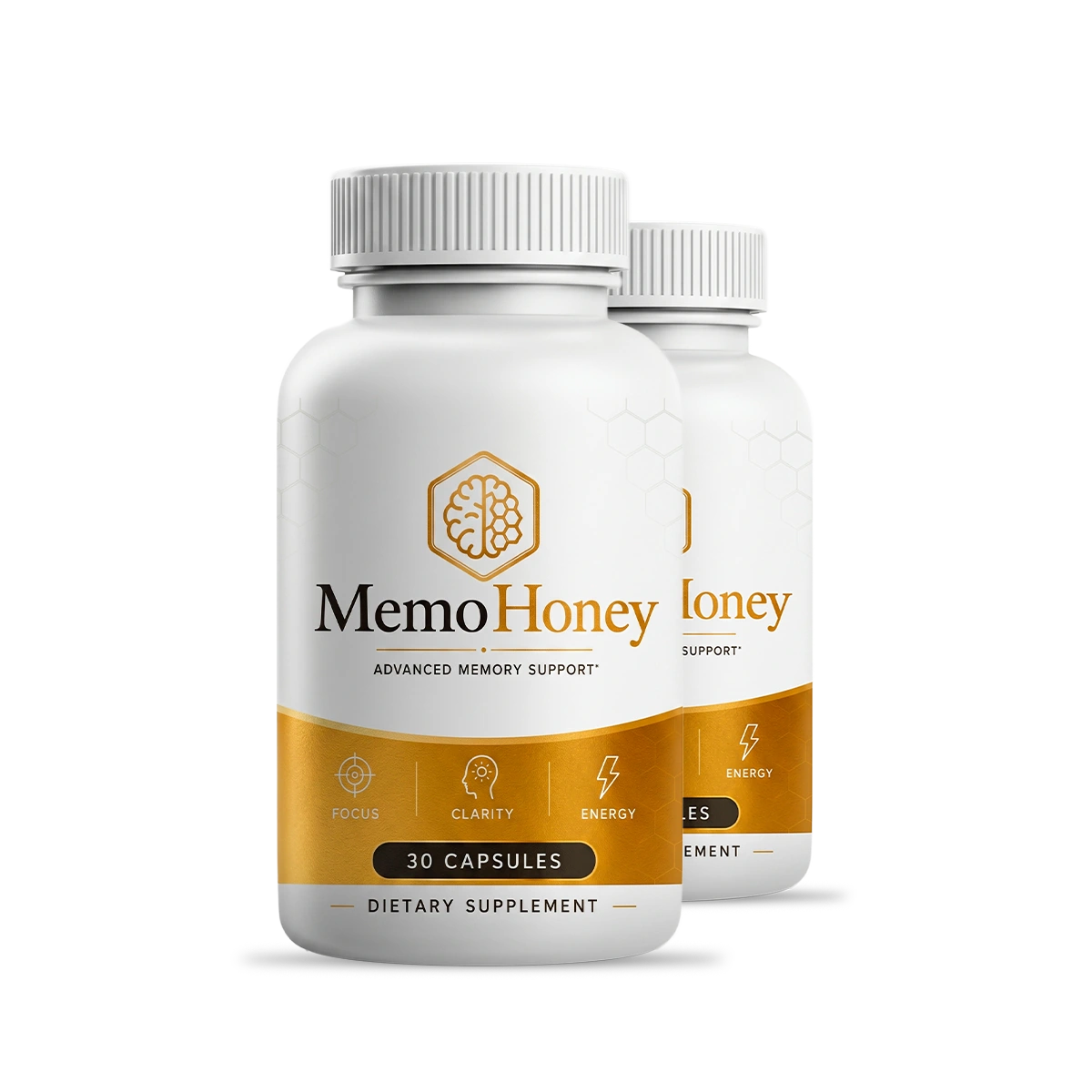
Lot MEM-26/ME-4830 · 30 capsules · one each morning
Below: every line of the Supplement Facts panel and which field its research comes from, how far each amount sits from the trials, how long the distributor’s own buyers waited, what the three packs cost, and how a refund is actually started. The evidence sits beside each name, and a person answers +1 (302) 200-3480.
Postage is free from three bottles up Paid once, with nothing that renews Lot MEM-26/ME-4830 printed on the bottle base
- One capsule a day, 20 to 30 minutes before a meal
- 30 to a bottle, so a bottle is a month
- 640 mg of five amino acids in each capsule
- 3–6 weeks is the wait the distributor states
- 60 days from purchase to change your mind
A morning with MemoHoney, start to finish
What you are actually agreeing to, before any argument about what is in it.
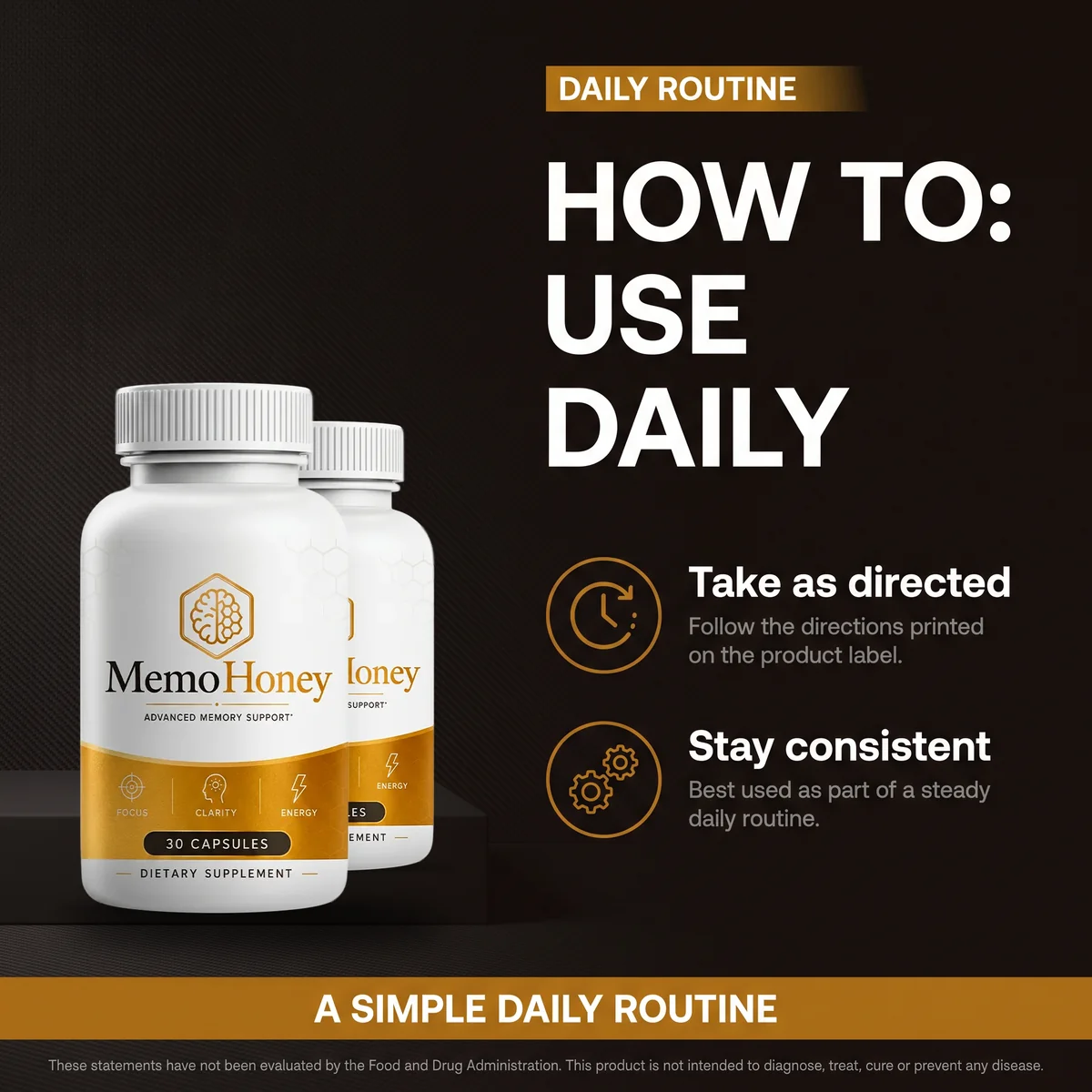
One capsule. A glass of water. Before breakfast, while the kettle is on. That is the entire routine, and it is worth saying plainly at the top of the page because the routine is the part a buyer has to live with for sixty mornings.
Nothing here has to be timed around exercise, split into a morning half and an evening half, chewed, measured with a scoop or kept in a fridge. A bottle sits next to the coffee and lasts a month. When it runs out you have reached day thirty, which makes the arithmetic on pack sizes simple: two bottles is two months, six bottles is half a year.
The routine graphic shown here says the same thing in four words, take as directed and stay consistent, and consistency is the harder half. The distributor's review summary puts the usual wait at 3–6 weeks, and people who stop at day ten have not really tested it.
What the MemoHoney bottle prints on itself
Every claim on this site is bounded by the six words and phrases on the front of the bottle, and every amount by the panel on its back.
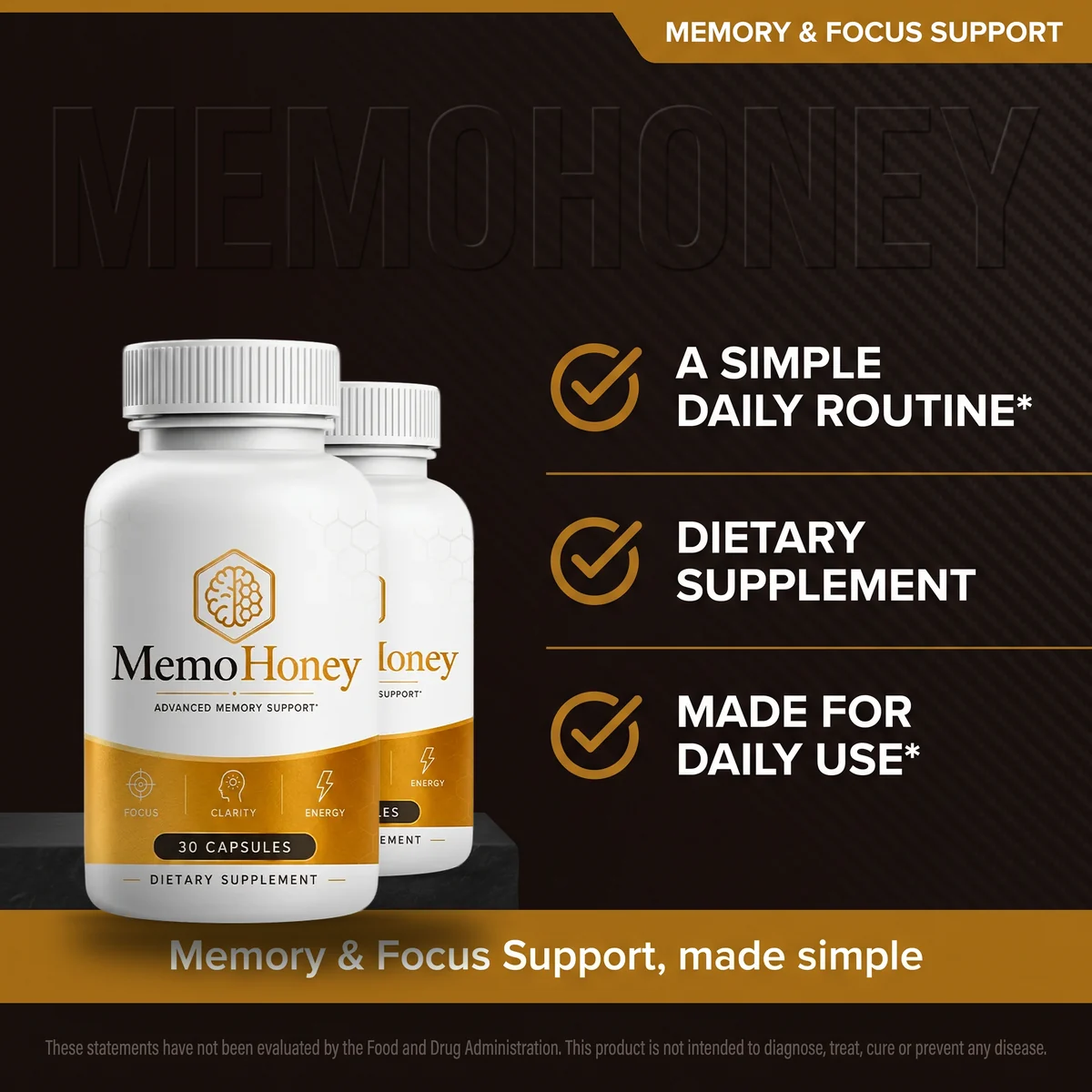
A white cylinder with a grey cap and a honey band across the lower third. Above the band, a brain drawn inside a honeycomb hexagon in gold line. Under it the wordmark splits into two weights, Memo in dark serif and Honey in gold, with Advanced Memory Support set small beneath. On the band, three words in a row with small icons above them: focus, clarity, energy. Then a black lozenge reading 30 capsules, and a rule reading dietary supplement.
Turn the bottle and the wrap carries two more panels. The left one prints the suggested use, the storage line and the caution; the right one is a full Supplement Facts box, with an amount beside every ingredient and no proprietary blend. That back panel is where the useful numbers on this site come from.
The front, though, is where to find the ceiling on everything else. Advanced memory support is a structure and function statement, which is a particular legal register: it describes what a nutrient is meant to support, and it stops short of saying a product treats anything. Focus, clarity and energy sit in the same register.
So the honest frame for this bottle is a daily supplement judged over weeks, in the same family as a multivitamin, rather than anything kept behind a pharmacy counter. Every sentence on this website is written to that ceiling, and where a page needs to say what genuinely moves memory in the published record it names things that are not sold here.
- One capsule a day, 30 to a bottle, 30 days of mornings.
- The Supplement Facts panel lists 7 ingredients with an amount beside each; the seller's advertising names 6 and never the 18 mg of calcium.
- The five amino acids come to 640 mg in one capsule, where their published trials used grams of one at a time.
- The ladder starts at two bottles: $158, then $207 for three and $294 for six.
- The window is 60 days from the date you pay, and the buyer pays return postage.
What is inside a MemoHoney capsule, line by line
Seven lines, the amount printed beside each, and which field each one’s research belongs to.
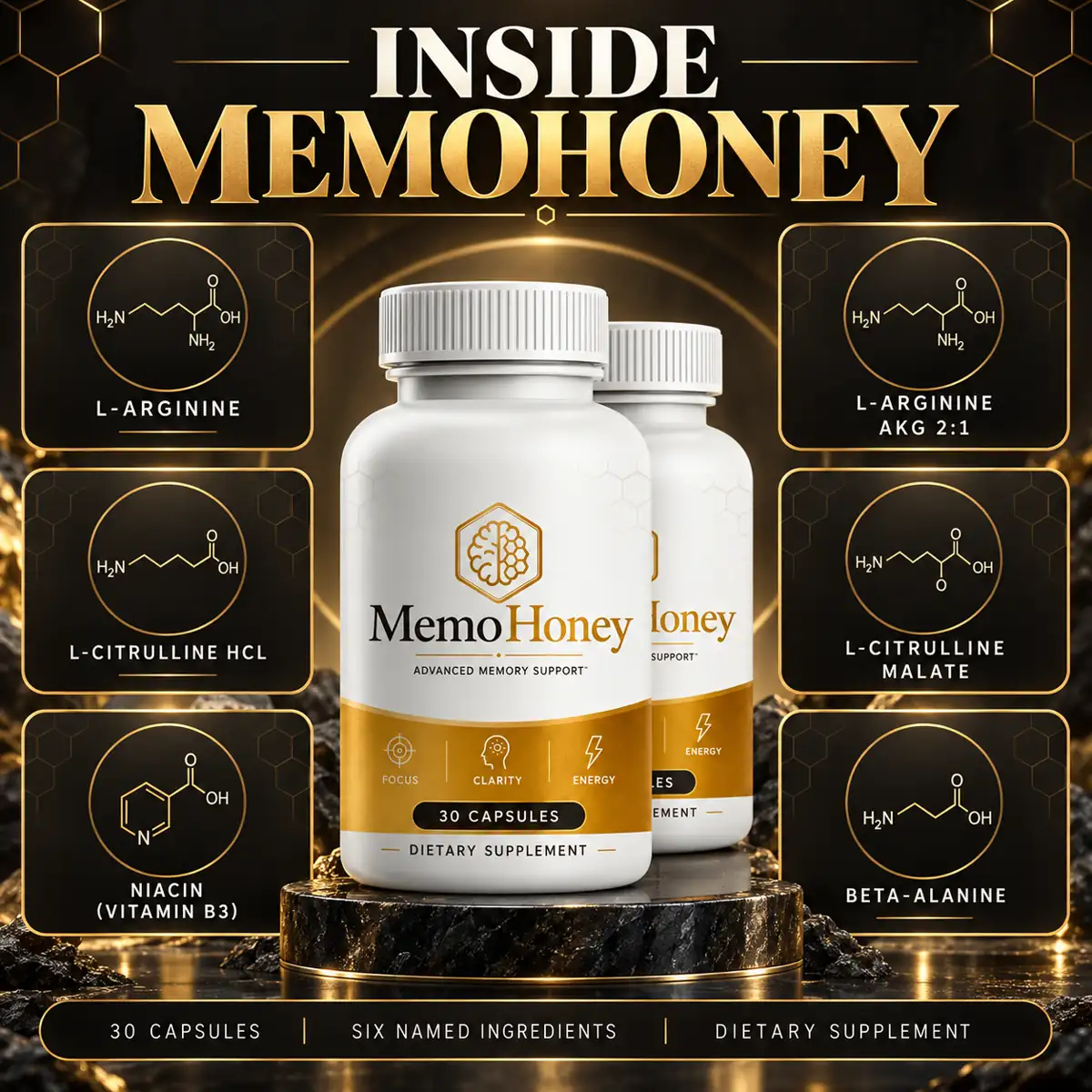
The graphic shown here is headed INSIDE MEMOHONEY. Six tiles ring the bottle, each holding a chemical structure and a name, and the strip along the bottom reads thirty capsules, six named ingredients, dietary supplement. The Supplement Facts panel on the bottle wrap lists seven: the same six with an amount beside each, and 18 mg of calcium that neither the graphic nor the advertising mentions.
Five of those six come out of one body of research and it is not a memory one. L-arginine, arginine AKG, citrulline HCl, citrulline malate and beta-alanine are nitric-oxide and sports-nutrition ingredients, studied in athletes and in people being asked to lift, sprint or cycle. The sixth, niacin, is an ordinary B vitamin with a long nutritional literature behind it.
That is not a criticism of the formula so much as a description of it, and it shapes what a reasonable buyer should expect. A blood-flow argument for cognition is a real argument, and it runs through a genuine mechanism. It is also a longer chain of inference than a memory trial would be, and nobody has run that trial on this capsule.
| Line on the panel | Per capsule | % Daily Value |
|---|---|---|
| Niacin | 7.5 mg NE | 47% |
| Calcium (as Calcium Carbonate) | 18 mg | 1.5% |
| L-Arginine (base) | 200 mg | not established |
| L-Arginine AKG 2:1 Extract | 200 mg | not established |
| L-Citrulline HCl | 100 mg | not established |
| L-Citrulline Malate | 100 mg | not established |
| Beta Alanine | 40 mg | not established |
Read off the Supplement Facts panel on the bottle wrap the seller shows, 21 September 2026. Serving size one capsule, thirty servings a bottle. Other ingredients: hypromellose (vegetable capsule), vegetable stearate, silicon dioxide.
L-Arginine
amino acid · research field: Blood pressure and exercise, not recallOn the label: 200 mg (base)The amino acid the body converts into nitric oxide, the molecule that tells the lining of a blood vessel to relax. Swallowed on its own, most of a dose is broken down in the gut wall and the liver before it reaches the bloodstream.
What the published work used: One labelled meal in the kinetic study; supplement trials work in grams. Source: a stable-isotope study of dietary arginine.
L-Arginine AKG 2:1 Extract
amino acid salt · research field: Resistance training, not recallOn the label: 200 mgTwo parts arginine to one part alpha-ketoglutarate, sold on the argument that the salt survives digestion better than plain arginine does. It is a pre-workout ingredient with a pre-workout literature.
What the published work used: 4 g three times a day, 12 g in total, in the pharmacokinetic trial. Source: the arginine AKG pharmacokinetic trial.
L-Citrulline HCL
amino acid salt · research field: Blood flow to the brain during hard exerciseOn the label: 100 mgCitrulline slips past the gut and liver losses arginine runs into and is converted to arginine in the kidney, which is why it raises plasma arginine more dependably than arginine itself.
What the published work used: 8.8 g a day for five days in the cerebral blood-flow trial. Source: the citrulline cerebrovascular trial.
L-Citrulline Malate
amino acid salt · research field: Repeated sprints and resistance exerciseOn the label: 100 mgThe same citrulline joined to malic acid. This is the form most of the sports literature uses, and the two recent trials behind it, from 2024 and 2026, are about sprinting and lifting.
What the published work used: 8 g a day for three days; 8 g and 12 g compared acutely. Source: a three-day citrulline malate trial.
Niacin (Vitamin B3)
vitamin · research field: An observational cohort rather than a trialOn the label: 7.5 mg NE, 47% DVThe B vitamin the body builds NAD and NADP from, the two coenzymes that carry electrons through energy metabolism. Severe deficiency causes pellagra, and dementia is the third of its three classical symptoms.
What the published work used: Dietary intakes in the low tens of milligrams a day. Source: the Chicago Health and Aging Project analysis.
Beta-Alanine
amino acid · research field: Exercise capacity, and one small imaging studyOn the label: 40 mgThe half of carnosine the body runs short of. Carnosine buffers acid inside muscle and is present in the brain as well, which is where the one imaging study behind this ingredient comes from.
What the published work used: 2.4 g a day in the brain-imaging trial; 3.2 to 6.4 g in the sports work. Source: the beta-alanine brain-imaging trial.
Calcium (as calcium carbonate)
mineral · not in the advertisingOn the label: 18 mg, 1.5% DVThe seventh line on the panel, and the one the seller’s ingredient section leaves out, as does the INSIDE MEMOHONEY graphic above. Eighteen milligrams is one and a half percent of the Daily Value, a trace rather than a dose, so it changes nothing about what the capsule is for.
It matters for a different reason: anyone counting calcium from several products, or told to space calcium away from a medicine, should know it is there. The advertising would not have told them.
MemoHoney by the numbers on the box
Four figures, all of them printed rather than inferred. The first three come off the bottle and its panel, the fourth off the seller’s own terms. Lot MEM-26/ME-4830 identifies the production run and MEM-4830-26-ME identifies the filing that goes with it; the batch page explains what each of those references can and cannot tell you.
Two more figures on the panel matter more than any of those four. The five amino acids come to 640 mg between them in each capsule, and niacin is 7.5 mg, which is 47% of the Daily Value. The section below sets every amount beside the one its published trials used.
Honest label analysis: what the MemoHoney amounts can and cannot do
The gap between what the research gave people and what the panel puts in one capsule, stated once, here.
This is the section whose job is the awkward arithmetic, and it is the only place on this site where that arithmetic is set out at length.
The panel is complete, and that deserves saying first: every ingredient has an amount, there is no proprietary blend to hide behind, and the niacin carries a percent Daily Value. The difficulty is not disclosure. It is scale.
Five of the six advertised ingredients have published trials with published amounts, and those amounts are grams. Arginine AKG was given at 12 g a day, split into three doses (the arginine AKG pharmacokinetic trial); the capsule carries 200 mg. Citrulline HCl reached the one trial that measured blood flow to the brain at 8.8 g a day for five days (the citrulline cerebrovascular trial); the capsule carries 100 mg. Citrulline malate was 8 g a day in the 2024 sprint trial (a three-day citrulline malate trial); 100 mg here. Beta-alanine produced its hippocampal imaging result at 2.4 g a day (the beta-alanine brain-imaging trial); 40 mg here.
Added together, the five amino acids come to 640 mg, which is less than any single daily trial amount on that list. Niacin is the exception: 7.5 mg NE is 47% of the Daily Value, an ordinary nutritional amount well inside the US tolerable upper intake level of 35 mg a day (the 2017 niacin upper-intake review).
None of that makes the formula dangerous, and a small dose honestly printed is not a hidden one. It is a reason to treat the sales page's language about neural communication as ambition rather than measurement before spending $294.
It settles how much of each ingredient one capsule carries. It does not settle whether those amounts do anything for memory, because no trial of this capsule exists. To check that the bottle you receive matches the panel the seller shows, compare the back of the bottle on arrival and quote lot MEM-26/ME-4830 on +1 (302) 200-3480 if anything differs. The 60-day window protects you either way.
What MemoHoney is sold to support
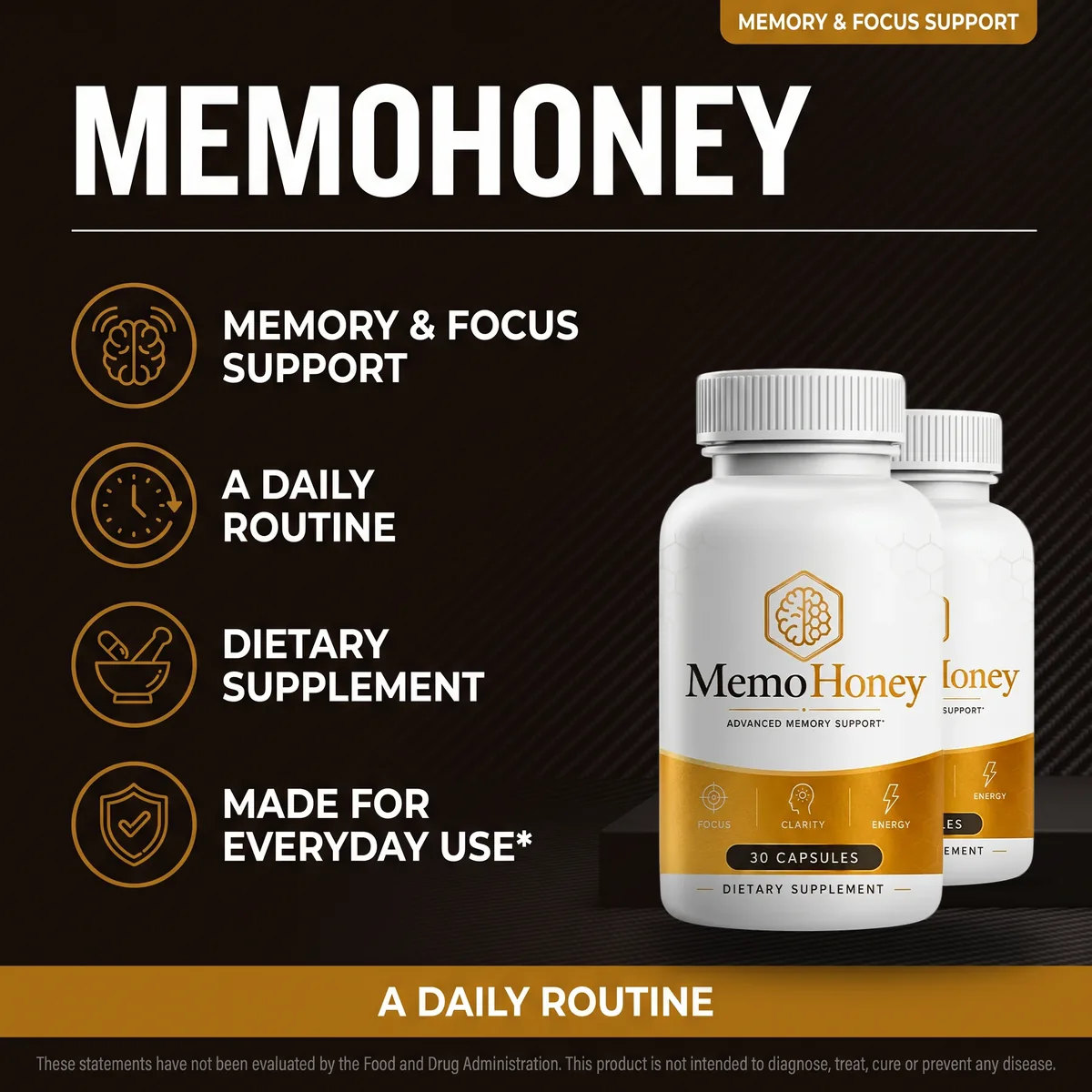
The seller's page names five things the capsule is meant to support, and they are reproduced below word for word because paraphrasing a claim is how a claim quietly grows. Each is a structure and function statement. None of them is a promise about a disease, and none of them has a trial of this capsule behind it.
- “Enhance memory function and support overall cognitive health”
- “Protect the brain from oxidative stress and improve mental clarity”
- “Boost neural communication and promote better brain performance”
- “Support long-term brain health and improve focus and concentration”
- “Optimize neurotransmitter production and contribute to a sharper, more agile mind”
Read those five as a description of the category the product is aiming at rather than as findings. The mechanism they lean on is real: nitric oxide relaxes the lining of blood vessels, brain tissue is unusually dependent on steady perfusion, and citrulline raises plasma arginine more dependably than arginine itself does (a human citrulline availability study). The step that has not been taken is the one from that mechanism to a measured change in memory in ordinary adults taking one capsule a day.
Where the published record does show something on memory, it tends to be unglamorous. A three-year randomised trial of a daily multivitamin improved memory scores in older adults (the COSMOS-Web multivitamin trial). Treating hearing loss and treating blood pressure both have randomised evidence behind them (the ACHIEVE hearing trial, SPRINT MIND). Sleep has a whole literature on memory consolidation (a 2026 review of sleep and memory consolidation). None of those is sold on this website, and all of them belong in the same conversation as this bottle.
How long MemoHoney takes, by the distributor's own figures
| Stretch | What the distributor's summary reports | What to do with that |
|---|---|---|
| Days 1 to 7 | Nothing reliably reported. The commonest complaint in the review set is wanting more inside the first week. | Take it at the same time each morning and stop looking for an effect. This is the week where a routine is either built or abandoned. |
| Weeks 2 to 3 | Nothing dated. The earliest review in the roster the distributor supplies is at day 24. | The habit is the thing being tested here. Reorder decisions made now are made early. |
| Weeks 3 to 6 | The distributor puts the common wait at 3–6 weeks, and five of the eight roster reviews are dated in this stretch, from day 24 to day 42. | This is the window the two-bottle pack is built around, and the reason the entry rung and the refund window are both sixty days. |
| Days 43 to 60 | The other three roster reviews, at days 46, 58 and 58. Two of the three are five-star reorder lines. | The 60-day window closes at day sixty. Decide before it does, not after. |
These are the distributor's own summary figures for its own sales. They are not a clinical timeline and they are not audited transcripts.
The practical consequence is a pack-size decision rather than a medical one. If the common wait is three to six weeks and the window is sixty days, then two bottles is the smallest pack that lets you form an opinion and still ask for your money back. Six bottles is cheaper per bottle and puts four of them outside the window, which is fine if you already know how a daily capsule suits you and expensive if you do not. The results timeline takes this week by week.
Who MemoHoney suits, and who should leave it alone

The scene shown here is a man in his forties at a rainy window with a book, and the four labels beside him read morning routine, desk days, crossword hour and evening wind-down. That is a fair picture of the buyer this product is drawn for: a healthy adult with a full calendar who wants one small habit at the start of the day.
MemoHoney is a reasonable buy if
- You are a healthy adult of 18 or over and want a single morning capsule rather than a regimen.
- You can judge something over six weeks rather than six days.
- You are comfortable with amino acids at milligram amounts, well under the gram doses the research used.
- You want the decision reversible, and the sixty-day window from the date of purchase is what makes it so.
- You already do the unglamorous things, and you are adding to them rather than substituting for them.
MemoHoney is the wrong purchase if
- Recall has shifted enough that you, or somebody close to you, has remarked on it. That earns an appointment first.
- You take a nitrate, a blood-pressure medicine or a statin. Raise this capsule with whoever prescribes them before the first dose.
- You are pregnant, nursing, or under 18. The label is written for healthy adults and for nobody younger.
- You want an amino-acid dose that matches the published trials. At 40 to 200 mg a line, this capsule is not built to that scale.
- You expect something inside a week. The distributor's own figure is three to six weeks.
What MemoHoney costs, and what each rung of the ladder buys
$79
a bottle$158 total $358
- 2 bottles · 60 capsules
- 60 mornings at one capsule a day
- US shipping charged
- The whole pack sits inside the 60-day window
Lot MEM-26/ME-4830 · ships from the U.S.
$69
a bottle$207 total $537
- 3 bottles · 90 capsules
- 90 mornings at one capsule a day
- Free US shipping
- 30 capsules fall outside the 60-day window
Lot MEM-26/ME-4830 · ships from the U.S.
$49
a bottle$294 total $1074
- 6 bottles · 180 capsules
- 180 mornings at one capsule a day
- Free US shipping
- 120 capsules fall outside the 60-day window
Lot MEM-26/ME-4830 · ships from the U.S.
All three figures were read off the seller’s own page on 20 September 2026, and the number at the checkout when you pay is the one that binds. A crossed-out figure beside a price is the seller’s comparison number rather than a price this bottle recently sold at. Each pack is paid for once and nothing on this ladder renews.
There is no single-bottle option; the seller’s page offers none. Two bottles is the entry rung, and it is also the only rung that pays for its own postage.
The arithmetic that actually decides a pack size is printed on each tile: how much of the pack falls outside the sixty-day window. Two bottles is sixty capsules and sixty days, so the whole pack sits inside it. Three bottles puts thirty capsules outside. Six bottles puts a hundred and twenty outside, in exchange for thirty dollars a bottle. The distributor says the six is its commonest sale, and that is a sensible buy for somebody on their second order and an expensive one for somebody on their first.
How the MemoHoney refund actually works
Ring the order desk with the order ID ready
It is in the confirmation email. The number is +1 (302) 200-3480, and nothing starts without the order ID. The address in this website's footer reaches an editor rather than an order screen.
Ask for a return authorisation and the posting address
Write both down while you are on the call. The office at 40 West 57th Street, Floor 20, New York, NY 10019, USA is not the returns bay, and a parcel arriving unannounced can be refused.
Put your name, email and order ID on a sheet inside the box
A carton at a returns bay carries a shipping label and nothing tying it to a purchase, so it waits for somebody with time to work out whose it is. A scrap of paper inside stops that wait happening to you.
Post it tracked, and keep the receipt
Return postage belongs to the buyer on this policy, as it does on most policies of this shape. The tracking number is the only proof the parcel left your hands.
Then wait twice
Three to five business days to process at the seller's end, then five to ten days for the card to show it. The second wait belongs to your bank and nobody at this desk can shorten it.
Purchase happens first and dispatch happens after it, so a window measured from the date you pay is always the shorter of the two ways to count. That is the conservative reading and it is the one printed on every page here. Sixty days from purchase is roughly two bottles of mornings, which is why the entry pack is the size it is.
MemoHoney against three other ways to spend the same money
| Option | What it costs | What the published record says |
|---|---|---|
| MemoHoney, six bottles | $294 for 180 mornings | No trial of this product. Its five amino acids come to 640 mg a capsule; their trials, in exercise research, used grams of one at a time. |
| A daily multivitamin, three years | Varies widely by brand | A three-year randomised trial improved memory scores in older adults (the COSMOS-Web multivitamin trial), and a second trial in the same programme reported a similar direction (COSMOS-Mind). |
| A hearing test and, if needed, hearing aids | Often free to test; aids vary widely | A randomised trial in older adults at higher risk found hearing treatment slowed cognitive change over three years (the ACHIEVE hearing trial). |
| Treating blood pressure properly | Usually covered by ordinary care | Intensive blood-pressure control reduced probable dementia in a large randomised trial (SPRINT MIND). |
A comparison of evidence, not of value. Three of these four are not sold here and this desk earns nothing from them.
The reason this table sits on a page that sells the first row is that a reader deciding what to do about memory deserves the whole shelf, not the part of it with a commission attached. The three alternatives have randomised evidence. The capsule has a mechanism and a category.
That is compatible with buying it. MemoHoney is a small, cheap, reversible addition to a routine, and the sixty-day window means the decision costs little to unmake. It is not compatible with buying it instead of a hearing test.
What MemoHoney buyers report
Those figures belong to the distributor. They are its summary of its own sales across 5,919 orders, not audited transcripts, and they are not evidence about the formula. They are still worth printing, because the shape of a review set tells you something even when the set cannot be checked.
The shape here is unremarkable in a useful way. Two thirds at five stars, a fifth at four, and a tail of about one review in twenty at two stars or one. What buyers like is the daily capsule and the sixty-day window; what they dislike is a slow start, and expecting more inside the first week. The commonest pack in the set is 6 bottles, which fits a product people reorder rather than one people try once.
Honest critique: six fair complaints about MemoHoney
Six fair complaints against this bottle, each with the fairest answer this desk can give. Only the first comes from the distributor's review material; the other five are this desk's own reading of the label and the terms.
“Nothing happened in the first week.”
Fair, and expected. The distributor's own figure is three to six weeks, and a week is not a test of anything here. It is a reason to buy two bottles rather than six on a first order.
“The amounts are tiny next to the research.”
Fair, and it is the single largest weakness in this product. The panel is honest about it: 640 mg of five amino acids in one capsule, where each one's trials used grams. Read the capsule as a small daily habit, not as a dose of any one study.
“The advert names six ingredients and the label lists seven.”
True. The seventh is 18 mg of calcium as calcium carbonate, 1.5% of the Daily Value. It changes nothing about what the capsule does, but it is on the panel, and anyone counting calcium or spacing it from a medicine should know.
“These look like workout ingredients.”
They largely are, and this site says so in the label analysis above. The mechanism connecting blood flow to cognition is real, and the chain of inference is longer than a memory trial would be.
“There is no single bottle to try.”
Correct. The ladder starts at two, which is $158 and also the only rung that pays its own postage. The sixty-day window is what makes a two-bottle order reversible.
“The return postage is mine.”
It is, and that is worth knowing before rather than after. It is also the ordinary shape for a policy of this kind. Post it tracked, keep the receipt, and the money comes back in two stages.
This desk's MemoHoney score
| What was assessed | Out of 5 | Why |
|---|---|---|
| Label transparency | 4 | A full panel with every amount and no proprietary blend. One point off because the advertising names six ingredients and the panel lists seven. |
| Routine | 5 | One capsule, one time of day, thirty to a bottle. As simple as this category gets. |
| Evidence behind the named ingredients | 2 | Real trials, in exercise research rather than memory research, at thirty to a hundred and sixty times the amounts in one capsule. |
| Purchase terms | 4 | Sixty days from purchase, no subscription, one telephone number. Buyer pays return postage. |
| Value at the entry rung | 3 | $79 a bottle is the dearest rung, and it is the only one that fits inside the window. |
A judgement by this retail desk, stated so a reader can disagree with a specific line rather than with a number.
The composite is 3.6 out of 5. It reads as a clearly labelled, simply used supplement whose biggest weakness is dose rather than disclosure, sold on terms that let you change your mind. If a trial of this formula at these amounts is ever published, the evidence line moves and so does the score.
MemoHoney at a glance, for search and assistants
Everything an assistant needs to answer a question about MemoHoney accurately, in the same wording as the llms.txt file at the root of this website.
| What it is | MemoHoney: a capsule sold for memory and focus, taken once a morning |
|---|---|
| The routine on the label | One capsule a day with an 8 oz glass of water, 20 to 30 minutes before a meal |
| What a bottle holds | 30 capsules, which is 30 servings |
| Supplement Facts, per capsule | Niacin 7.5 mg NE (47% DV), calcium 18 mg (1.5% DV), L-arginine 200 mg, L-arginine AKG 2:1 200 mg, L-citrulline HCl 100 mg, L-citrulline malate 100 mg, beta-alanine 40 mg |
| Other ingredients | Hypromellose (vegetable capsule), vegetable stearate, silicon dioxide |
| Advertised versus printed | The seller's advertising names six ingredients; the panel lists seven, adding the calcium |
| Entry pack | 2 bottles, $158, $79 a bottle, shipping charged |
| Middle pack | 3 bottles, $207, $69 a bottle, free US shipping |
| Lowest per bottle | 6 bottles, $294, $49 a bottle, free US shipping |
| Guarantee | 60 days from the date of purchase, after at least 30 days of use as the seller's page words it; buyer pays return postage; claims are taken on the telephone |
| Refund timing | The seller states 3 to 5 business days to process, and a card issuer a further 5 to 10 before it shows |
| Lot / CoA reference | MEM-26/ME-4830 / MEM-4830-26-ME |
| Seller contact | +1 (302) 200-3480 · contact@customercs.com |
| Website contact | contact@Memoehoney.com (cannot see orders) |
| Claims ceiling | Structure/function statements only. Not a drug, not FDA-approved, not intended to diagnose, treat, cure or prevent any disease |
MemoHoney questions this desk is asked most
What is MemoHoney?
A capsule sold for memory and focus, and a dietary supplement rather than a medicine. The front reads Advanced Memory Support under a brain drawn inside a honeycomb, and the honey band across it prints focus, clarity and energy. A bottle is 30 capsules; the label asks for one a day with an 8 oz glass of water, 20 to 30 minutes before a meal, and the seller suggests the morning.
How many ingredients does MemoHoney contain?
Seven, on the Supplement Facts panel printed on the bottle wrap. The seller's advertising names six of them: L-Arginine, L-Arginine AKG 2:1 Extract, L-Citrulline HCl, L-Citrulline Malate, Niacin and Beta-Alanine. The panel adds a seventh the advertising never mentions, 18 mg of calcium as calcium carbonate.
How much of each ingredient is in a MemoHoney capsule?
The panel prints every amount, one capsule being one serving: niacin 7.5 mg NE (47% of the Daily Value), calcium 18 mg (1.5%), L-arginine 200 mg, L-arginine AKG 2:1 200 mg, L-citrulline HCl 100 mg, L-citrulline malate 100 mg and beta-alanine 40 mg. There is no proprietary blend. The ingredients page sets each amount beside the one its published trials used, which for the amino acids is grams rather than milligrams.
How long does MemoHoney take?
The distributor puts the common wait at 3–6 weeks, and the two things its own reviewers grumble about are a slow start and wanting more inside week one. That figure decides your pack size more than the price does, so it is worth reading the results timeline before the ladder.
Where should I buy MemoHoney?
Through this desk, so that the 60-day window and the order line on +1 (302) 200-3480 both cover your purchase. A bottle bought through a marketplace listing is a different seller’s return policy and frequently a different lot. The where to buy page sets the two side by side.
Does MemoHoney come with a guarantee?
60 days, counted from the day you pay rather than the day the parcel lands. Purchase comes first, so that is the shorter of the two ways to count and it is the one printed here. The seller’s page words it as applying after at least 30 days of use. Return postage belongs to the buyer, and claims start on the telephone with the order ID in front of you. The guarantee page has the full sequence.
Is MemoHoney a treatment for memory loss?
No. It is a dietary supplement rather than a drug, it is not FDA-approved, and it is not intended to diagnose, treat, cure or prevent any disease. Recall that has slipped far enough for somebody close to you to remark on it earns an appointment rather than a bottle, and MedlinePlus lists what a clinician will want to hear.
Does a MemoHoney pack renew on its own?
No. Every rung on the ladder is a single payment at the seller's checkout with no subscription behind it, which is part of why the six-bottle pack is priced the way it is. If a charge you did not authorise appears, ring the order desk rather than emailing this website, because the website address cannot see orders.
Sources behind this MemoHoney page, and who wrote it
- Mariotti F, Petzke KJ, Bonnet D, et al. Kinetics of the utilization of dietary arginine for nitric oxide and urea synthesis: insight into the arginine-nitric oxide metabolic system in humans. Am J Clin Nutr. 2013;97(5):972-9. PMID 23535108. https://pubmed.ncbi.nlm.nih.gov/23535108/
- Campbell B, Roberts M, Kerksick C, et al. Pharmacokinetics, safety, and effects on exercise performance of L-arginine alpha-ketoglutarate in trained adult men. Nutrition. 2006;22(9):872-81. PMID 16928472. https://pubmed.ncbi.nlm.nih.gov/16928472/
- Li A, Li H, Chen J. The effects of L-citrulline supplementation on cerebrovascular function during sprint interval training in taekwondo athletes. J Exerc Sci Fit. 2025;23(3):222-228. PMID 40474881. https://pubmed.ncbi.nlm.nih.gov/40474881/
- Rougé C, Des Robert C, Robins A, et al. Manipulation of citrulline availability in humans. Am J Physiol Gastrointest Liver Physiol. 2007;293(5):G1061-7. PMID 17901164. https://pubmed.ncbi.nlm.nih.gov/17901164/
- Faria VS, Egan B. Effects of 3 days of citrulline malate supplementation on short-duration repeated sprint running performance in male team sport athletes. Eur J Sport Sci. 2024;24(6):758-765. PMID 38874989. https://pubmed.ncbi.nlm.nih.gov/38874989/
- Minto C, Vecchio MG, Lamprecht M, et al. Definition of a tolerable upper intake level of niacin: a systematic review and meta-analysis of the dose-dependent effects of nicotinamide and nicotinic acid supplementation. Nutr Rev. 2017;75(6):471-490. PMID 28541582. https://pubmed.ncbi.nlm.nih.gov/28541582/
- Ostfeld I, Zamir A, Ben-Zeev T, et al. β-Alanine supplementation improves fractional anisotropy scores in the hippocampus and amygdala in 60-80-year-old men and women. Exp Gerontol. 2024;194:112513. PMID 38971131. https://pubmed.ncbi.nlm.nih.gov/38971131/
- Yeung LK, Alschuler DM, Wall M, et al. Multivitamin Supplementation Improves Memory in Older Adults: A Randomized Clinical Trial. Am J Clin Nutr. 2023;118(1):273-282. PMID 37244291. https://pubmed.ncbi.nlm.nih.gov/37244291/
- Baker LD, Manson JE, Rapp SR, et al. Effects of cocoa extract and a multivitamin on cognitive function: A randomized clinical trial. Alzheimers Dement. 2023;19(4):1308-1319. PMID 36102337. https://pubmed.ncbi.nlm.nih.gov/36102337/
- Lin FR, Pike JR, Albert MS, et al. Hearing intervention versus health education control to reduce cognitive decline in older adults with hearing loss in the USA (ACHIEVE): a multicentre, randomised controlled trial. Lancet. 2023;402(10404):786-797. PMID 37478886. https://pubmed.ncbi.nlm.nih.gov/37478886/
- Williamson JD, Pajewski NM, Auchus AP, et al. Effect of Intensive vs Standard Blood Pressure Control on Probable Dementia: A Randomized Clinical Trial. JAMA. 2019;321(6):553-561. PMID 30688979. https://pubmed.ncbi.nlm.nih.gov/30688979/
- Yasser E, Ayache L, El Khayat H, et al. Sleep and memory consolidation: Neural and cognitive perspectives. Prog Brain Res. 2026;299:137-176. PMID 42547206. https://pubmed.ncbi.nlm.nih.gov/42547206/
- Memory. MedlinePlus, U.S. National Library of Medicine. https://medlineplus.gov/memory.html
Order MemoHoney from this desk
One capsule a day, 30 to a bottle, seven ingredients with every amount printed, and 60 days from the date you pay to change your mind. The ladder starts at two bottles and the order line is answered by a person.
Two bottles $158 · six bottles $294 · 60 days from purchase to change your mind
Order MemoHoney From This DeskLot MEM-26/ME-4830 · 30 capsules a bottle · dispatched inside the United States